Ourika Valley

- Our mission in our own words, and what it changes day to day
- Who earns from your day in the valley, stop by stop
- Women who work: cooperatives, weaving, home cooking
- Local products worth buying and how to buy them fairly
- Life after the 2023 earthquake and the October 2026 floods
- Writers, bloggers and journalists: how to help us spread the word
Short answers
Who earns from a day trip in the Ourika Valley?
On a private Ourika Valley day trip, the vehicle price of 120 EUR for 1 to 7 people (200 EUR for 8 to 17) pays a local driver, and the guide option of 40 or 80 EUR per group pays a guide from the valley. Lunch is paid at the menu price to family restaurants by the river, and cooperative purchases go to women members.
Is the Ourika Valley open after the October 2026 floods?
Yes, life in the Ourika Valley has been back to normal since 13 October 2026. The storms of 2 October 2026 sent mud and stones onto the road towards Setti Fatma; the press reported no victims and local authorities cleared it section by section. Restaurants, cooperatives and guides are working, and the team checks alerts, road and river before each trip.
How do women's cooperatives work in Morocco?
Moroccan cooperatives are governed by Law 112-12 of 2014: they need at least five members, are registered with the ODCO, and share their distributed surplus according to each member's work after a reserve is set aside. Morocco had about 60,000 cooperatives in 2023, of which 7,730 were entirely female, and women made up 32% of members.
How can travellers help the villages of the Ourika Valley?
Spend inside the Ourika Valley, directly with the people who do the work: a local guide, a riverside lunch, a piece bought from its maker, paid in cash in dirhams. Ask before photographing anyone, cover shoulders and knees, and give nothing to children on the roadside. To donate, choose a registered Moroccan association and give through its official channels.
Our mission is to improve the lives of the people and villages of the Ourika Valley and the villages around it, through social and solidarity tourism: we promote local trade and local tourism, local products, and the women who work. We are a local team of drivers and guides from the valley, and we put that into practice in simple ways. Your driver and your waterfall guide are local, lunch is taken in family restaurants by the river where you pay the menu price directly, families who cook for you are paid for the meal, and cooperatives run by women are visited with no pressure to buy. Under Morocco's Law 112-12 of 2014, a cooperative shares its distributed surplus among its members according to their work, so buying there gives women an income of their own. The valley is open: the 2023 earthquake and the floods of 2 October 2026 left marks, and life has returned to normal since 13 October 2026. To help as a visitor, spend inside the valley, buy from the maker, ask before photos and give nothing to children on the roadside.
Most of us grew up in these villages. Our drivers learned the road with their fathers, our guides walked to school along the seguias, and the families who cook for our guests are neighbours and cousins. This page is not a brochure. It is what we tell visitors who ask why we work the way we do.
What is our mission?
In October 2026 the owner of ourika-valley.com put it in one sentence, and we keep his words as our compass:
"Our main goal is to improve the lives of the people and villages of the Ourika and the villages around it, to promote local trade and local tourism, within social tourism (solidarity tourism), by giving value to local products and to the women who work."
Each part of that sentence has a practical meaning for us.
"The people and villages of the Ourika and around it." We do not work only for Setti Fatma, the village at the end of the road. The valley is a chain of communities, from Tnine Ourika at its entrance to the hamlets on the slopes, and many of the people who cook, weave or guide live off the main road. We try to spread visits along the whole valley rather than piling everyone into one spot.
"Local trade and local tourism." Money paid to a guide, a family restaurant or a potter of the valley stays with families of the valley. A day organised by people from the valley keeps more of what you spend inside it. This is also why we publish our prices and take bookings directly, without a platform commission taken out of the price, as we explain in why book direct.
"Social tourism, solidarity tourism." The United Nations defines sustainable tourism as tourism that "takes full account of its current and future economic, social and environmental impacts, addressing the needs of visitors, the industry, the environment and host communities", and one of the Sustainable Development Goals (target 8.9) calls for tourism that "creates jobs and promotes local culture and products". We are a small team, not a policy, but that is exactly the kind of tourism we want for our valley: visitors welcome, and residents better off.
"Local products and the women who work." In the valley, women carry a huge part of the work: in the fields, with the animals, at the bread oven and at the loom. Cooperatives and home-based crafts are among the few ways for them to earn their own money. Showing that work to visitors, explaining it properly and letting people buy at a fair price is at the centre of what we do.
What it means day to day
Our about page describes how we organise trips. In short:
- Private vehicles and small groups. You are not one of fifty people at each stop, and you do not overwhelm a village.
- Local drivers and valley guides. The people who earn from your day are the people you spend it with.
- Local lunch places. Family-run restaurants by the river, where you pay the menu price directly, like everyone else.
- Fair cooperative visits. We explain how things are made and let you decide. A visit is a success when you understood the place, not when you bought a rug.
- Published prices. Every price is shown before you confirm; you pay a 50% deposit online and the balance to the driver on the day.
- Safety first. In summer and during storm alerts we watch the sky and the river; if the valley is unsafe on your date, we propose another date or refund your deposit in full.
Who earns from your day in the valley?
The answer to "does my visit help?" depends on where the money goes. Here is who you meet on a typical day with us, and how your visit supports them.
| Who | What they do | How your visit supports them |
|---|---|---|
| Our driver | Picks you up in Marrakech and drives the valley road | The vehicle price (120 EUR for 1 to 7 people, 200 EUR for 8 to 17) pays a local driver |
| Valley guide | Leads the walk to the waterfalls and explains the villages | The guide option (40 EUR per group for 1 to 7, 80 EUR for 8 to 17) pays a guide from the valley for his day |
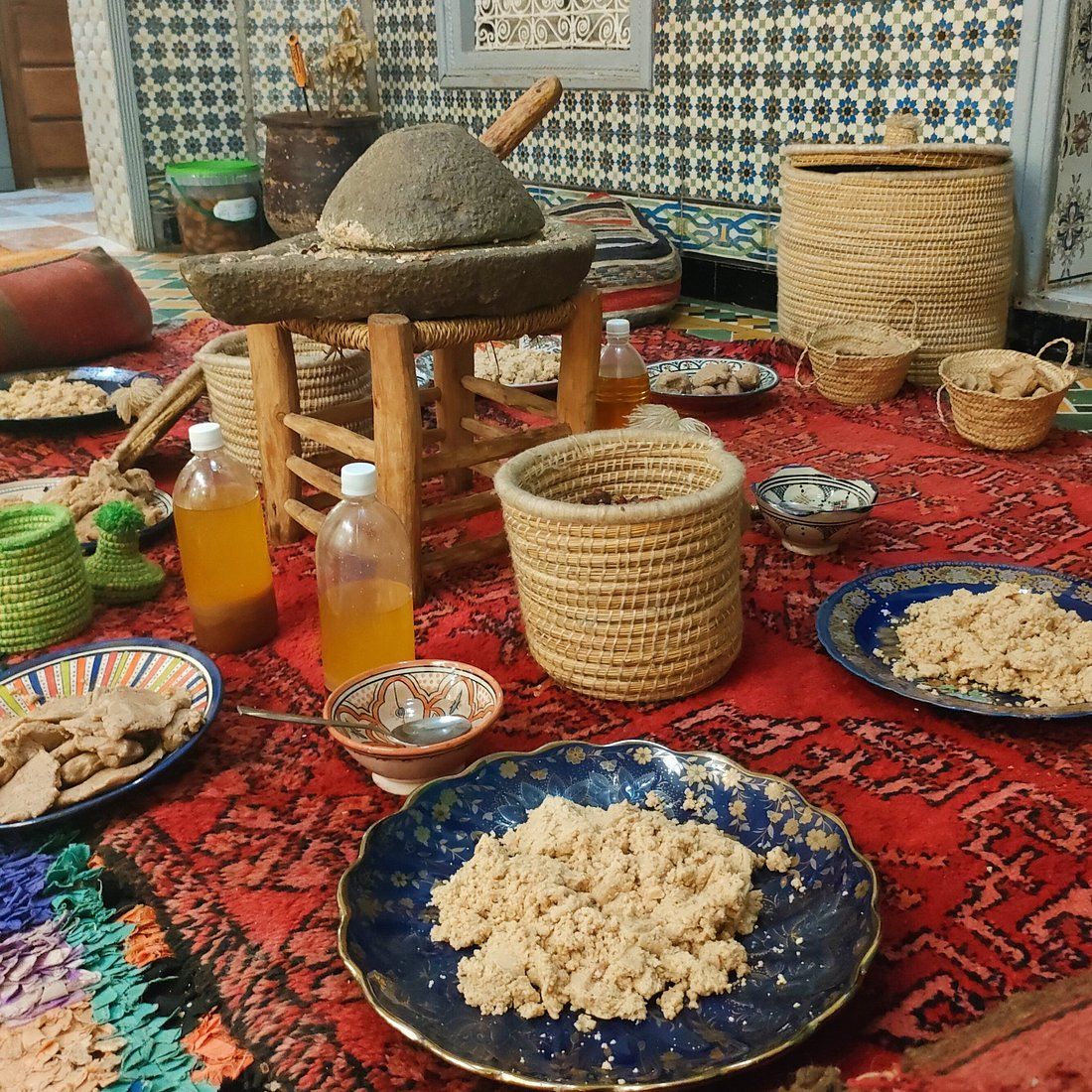
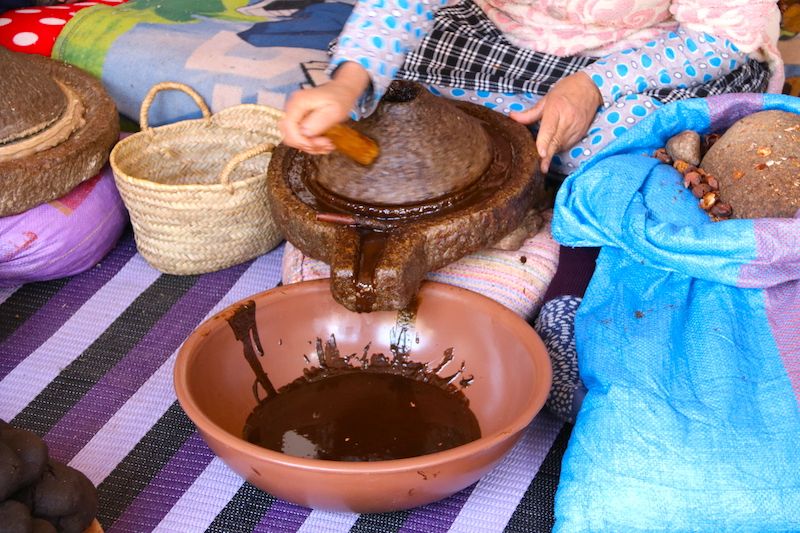
| Women's argan cooperatives | Crack, grind and knead argan kernels by hand and sell the oil | The demonstration is free; what you buy at the marked price goes to a cooperative owned by its members |
| Potters | Shape and fire red clay in roadside family workshops | Buying a tagine at the workshop pays the maker directly |
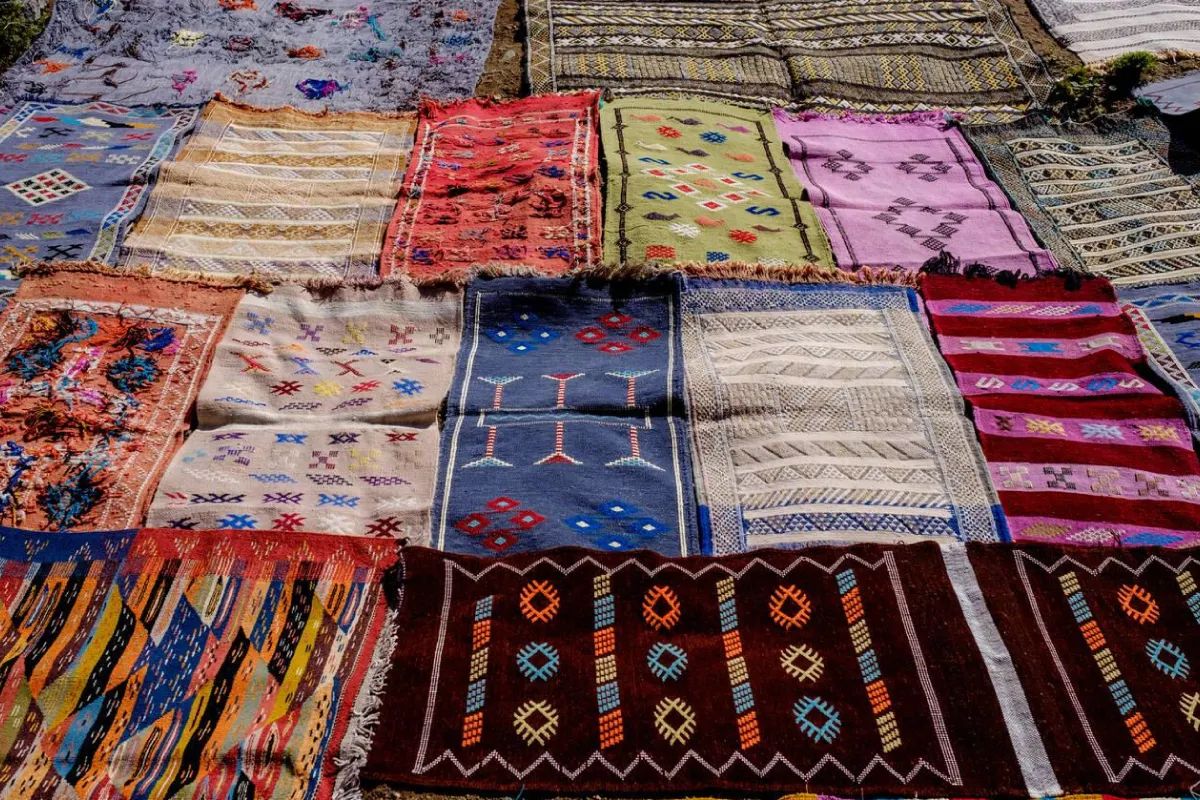
| Weavers | Weave rugs and blankets at home or in cooperatives | Buying from the family or a cooperative rewards weeks of work at the loom |
| Family lunch and cooking class hosts | Cook a home meal for you in a village house | The family is paid for the meal or the class, and that income stays in the village |
| Riverside restaurants | Family businesses that cook tagines and squeeze orange juice | You pay the menu price directly to a family business |
| Monday souk sellers | Farmers and traders at Tnine Ourika | Walking through costs nothing; buying fruit or spices goes straight to the seller |
None of these people work for a large company. Most combine tourism with farming, which is why every visit, even a short one, counts.
The villages along the valley
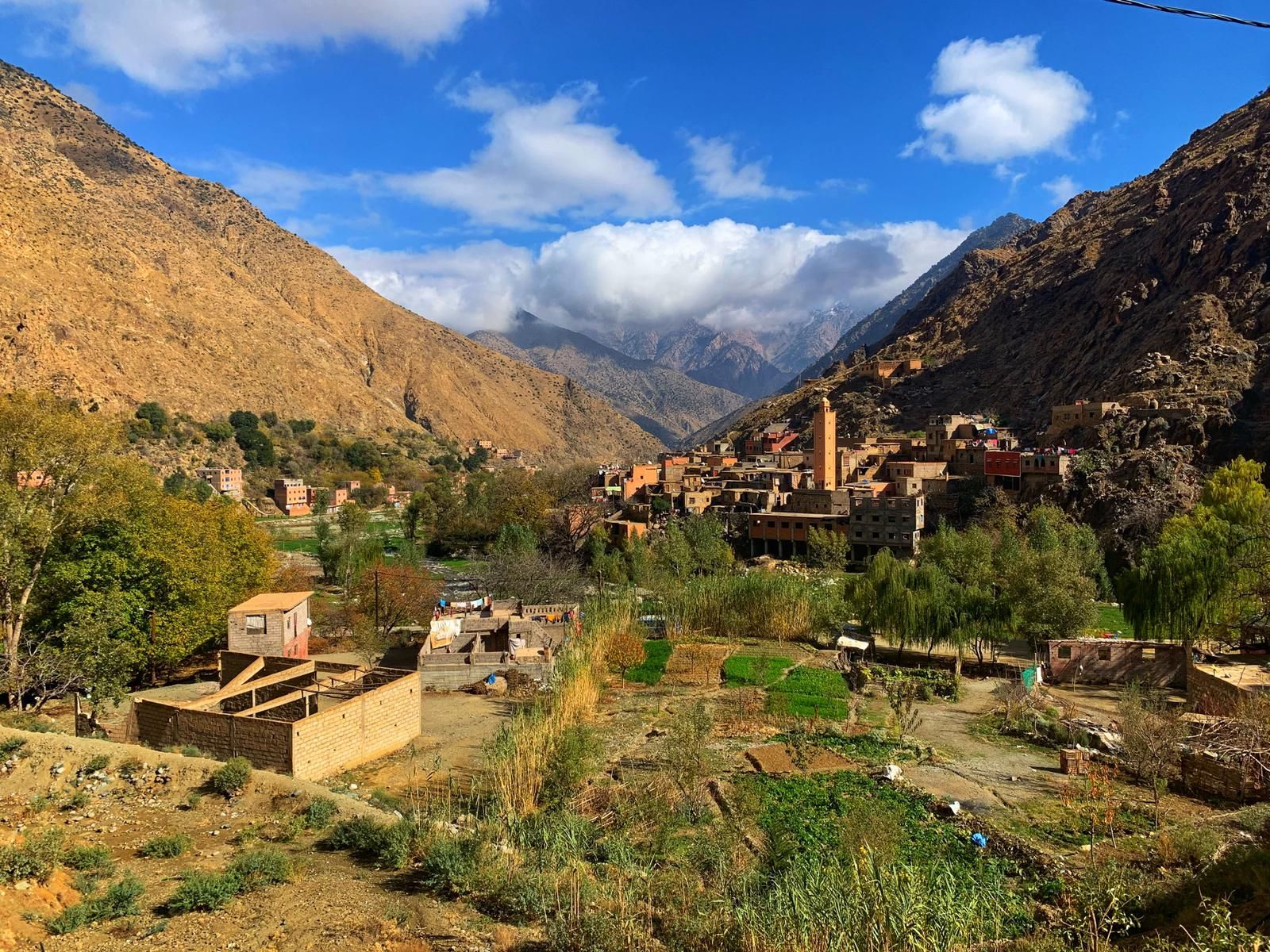
The Ourika Valley is one road that follows the river from Marrakech to Setti Fatma, about 63 km from the city centre, as our map of the valley shows. The villages along it live from the same river, but each has its own place in the life of the valley.
Tnine Ourika, the market town
About 36 to 38 km from Marrakech, Tnine Ourika sits at the entrance of the valley. Tnine means Monday, the day of its weekly souk, when families from the villages come down to sell what they grow and buy what they need. It is also where clinics, secondary schools, banks and administrations are, so for many villagers it is the place of errands as much as of trade. Our guide to the Monday souk of Tnine Ourika explains how to visit it.
Tafza and the villages near the entrance
Near Tnine Ourika, the village of Tafza is home to the Berber ecomuseum, reported closed since the September 2023 earthquake. Until it reopens, we replace it with a walk through a village near Tnine Ourika. The roadside potteries and several argan cooperatives are in this lower part of the valley.
Aghbalou, the crossroads
In the middle of the valley, at Aghbalou, a mountain road branches off and climbs to the Oukaïmeden plateau, at about 2,600 m, where flocks have gone up to summer pastures for a very long time. The Oukaïmeden page describes the plateau.
Setti Fatma and the hamlets above it
The road ends at Setti Fatma, at about 1,500 m, with its footbridges, river restaurants and the path to the waterfalls. The rural commune of Sti Fadma, which groups the village with many hamlets on the slopes, had 24,159 inhabitants at the 2024 census of the High Commission for Planning. Above it, in the upper Ourika, mountain paths lead to villages such as Timichi and link the valley to Oukaïmeden and Imlil.
Women who work: cooperatives and crafts
Women do much of the farm and household work in the valley, and their crafts are among the products visitors take home. Here is why buying direct from them matters.
Why cooperatives matter
A cooperative is a group of people who pool their work and share the income. In Morocco, cooperatives are governed by Law 112-12 of 2014: they need at least five members, are registered with the Office du Développement de la Coopération (ODCO), and the surplus they distribute goes to members according to the work they did, after a share is set aside in reserve. According to the Ministry of Tourism, Handicraft and Social and Solidarity Economy, Morocco had about 60,000 cooperatives in 2023, of which 7,730 were entirely female, and women made up 32% of members. In rural areas, cooperatives are one of the few ways for women to earn an income of their own.
Argan oil, woven rugs, home cooking
- Argan oil. The argan tree does not grow in Ourika: the women's cooperatives of the valley buy their kernels from the south-west of Morocco and do the cracking, grinding and kneading by hand in front of you. Our guide to argan oil explains the steps and how to spot a real oil.
- Rugs. In the Amazigh villages of the Atlas, weaving is traditionally women's work, at home or in cooperatives. Our guide to Berber rugs explains types and quality.
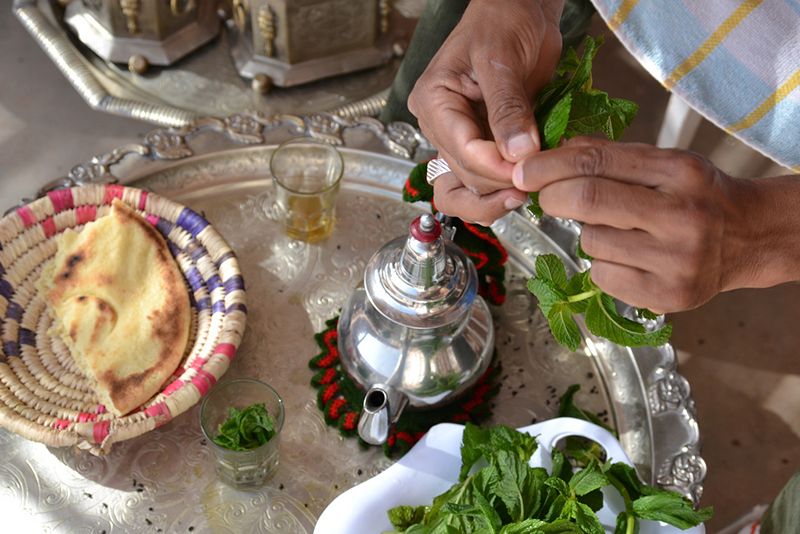
- Home cooking. The best tagines in the valley are cooked at home. Our trek and lunch with a Berber family and our cooking class, both 60 EUR per person, take place in family houses, and the family is paid for its work.
Our private cooperatives and villages tour, with driver and local guide at 120 EUR per vehicle for 1 to 7 people, puts these visits together in one day, at your pace, with no shopping pressure.

Local products worth buying, and how to buy them fairly
You do not need to buy anything to have a good day. If you want to take something home, these are the products made or sold by people of the valley, with the habits that keep the deal fair for both sides.
| Product | Where to buy it | How to buy fairly |
|---|---|---|
| Argan oil and amlou | Women's argan cooperatives on the valley road | Prices are usually marked and fixed; ask the price per litre to compare sizes |
| Cooking tagines and bowls | Roadside potteries between Marrakech and Tnine Ourika | Bargaining is normal; pay cash in dirhams, and see our pottery guide on choosing a tagine |
| Berber rugs and blankets | Village cooperatives and shops along the road | Ask where and by whom the rug was made; fixed prices in cooperatives, friendly bargaining in shops |
| Fruit, olives, herbs and spices | The Monday souk of Tnine Ourika | Food is sold by weight at low, practically fixed prices: do not haggle |
| A home-cooked meal | A family house, on our family lunch or cooking class | The price is set in advance and paid for the meal; a tip is a kind gesture, never an obligation |
Three habits cover almost every situation:
- Ask whether the price is fixed before you negotiate. In a cooperative, it usually is.
- Only ask a price if you might buy, and never name a price you would not pay. Once agreed, it is agreed.
- Bring cash in dirhams. Small workshops and families rarely take cards. There are cash machines in Tnine Ourika.
Life in the mountains, the 2023 earthquake and the October 2026 floods
We do not want to paint the valley as poor or sad. It is not. But mountain life has real difficulties, and knowing them helps you understand why your choices as a visitor matter.
Farming, water and the second income
Families farm narrow terraces held up by dry stone walls, watered by seguias that take water from the river and share it by turns between families. Orchards of walnut, apple, cherry, olive, almond and quince grow between the fields, and most families keep a few sheep, goats, a cow or a mule. Farming alone rarely covers a family's needs, so almost every household has a second income, very often from tourism, and many young people leave for Marrakech for work that pays every month. Our page on the people of the valley tells the story of village life in more detail.
Distance to services and school
Many villages sit high above the road, reached by tracks or footpaths. Clinics, secondary schools and banks are in Tnine Ourika or in Marrakech. Primary schools exist in or near many villages, but secondary school usually means going down to a town, and for girls from remote villages this has long been the moment when schooling stopped. In the valley there is a dar taliba, a boarding house for girls, created so that girls from remote villages of the Ourika can continue their education beyond primary school.
The 2023 earthquake
On the night of 8 September 2023 a magnitude 6.8 earthquake struck the High Atlas, with its epicentre in Al Haouz province, the province of the Ourika Valley. National authorities reported about 2,950 deaths within a week, most of them in mountain villages where old houses of stone and earth could not resist. The Ourika Valley was further from the epicentre than the worst-hit areas, but villages in and around it were affected, and many families spent the following winter in tents. The state announced a five-year reconstruction programme of about 120 billion dirhams for the affected regions. Rebuilding in the mountains is slow: materials must be carried up, and families want houses that are both safe and adapted to the cold. Our history page puts these events in context.
The floods of October 2026
The river gives life to the valley, and it can also take it: every family remembers the flash flood of 17 August 1995. On the evening of Friday 2 October 2026, strong storms over the heights sent muddy torrents down the ravines, pushing mud and stones onto the road towards Setti Fatma, as reported by Al Oumma on 5 October. The press reported no victims, and machines from the local authorities cleared the road section by section. Orange weather alerts followed until 10 October. Since 13 October 2026, life in the valley is back to normal, and the restaurants, cooperatives and guides are working. Our page on the October 2026 floods gives the details.
How can you help as a traveller?
Good intentions can go wrong. These are the habits we ask of all our guests.
Do
- Spend inside the valley, directly with the people who do the work: a local guide, a riverside lunch, a piece bought from its maker.
- Ask who is behind your trip. Who is the driver, who is the guide, which restaurant? A tour run by people from the valley keeps more of your money in the valley.
- Ask before taking photos. People here are hosts, not scenery. Point to your camera, wait for a yes, and accept a no. Many women prefer not to be photographed.
- Dress with respect. Cover shoulders and knees in the villages, for men and women.
- Learn two words. Azul is the Amazigh greeting and tanmmirt means thank you. Conversations often start there.
- Respect prayer times and places. Lower your voice near the mosque at the call to prayer; during Ramadan, avoid eating, drinking or smoking openly in the streets during the day.
- Stay a night if you can. An overnight stay in a local guesthouse spreads your spending over dinner, breakfast, a guide and a morning walk; see where to stay.
Don't
- Do not give money, sweets or pens to children. It teaches them that asking tourists pays better than school, and sweets damage teeth far from any dentist. A smile and a greeting are welcome.
- Do not step on the edges of the seguias or move their stones: a small breach can dry a neighbour's field.
- Do not enter a courtyard or house without an invitation.
- Do not hand cash or goods to individuals on the roadside to "help". If you want to give, choose a registered Moroccan association, check what it actually does, and give through its official channels.
- Do not haggle over food at the souk, and do not turn bargaining for a rug into a contest. Winning the last ten dirhams is not a victory.
Writers, bloggers and journalists: help us spread the word
The valley does not need pity, it needs visitors who come well informed. If you write about Morocco, travel, food, crafts or responsible tourism, you can help in a simple way.
- Share your own experience, good or less good, as you lived it. Honest accounts are more useful to travellers than any brochure.
- Mention or link this page or our site when you write about the Ourika Valley, its cooperatives or how to visit responsibly, if you think it helps your readers.
- Ask us for information. We are happy to answer questions on the valley, its villages, the cooperatives, the weather and the state of the road, and to check facts with our guides. Write to booking@ourika-valley.com or on WhatsApp at +212 661 454 738.
To be clear: we do not pay for articles or links, and we do not offer free trips in exchange for coverage. What we can offer is time, local knowledge and straight answers.
Come and meet the people behind this page
When you travel with us, you meet our drivers, our valley guides, the cooks by the river and the women of the cooperatives. Our private day trip costs 120 EUR per vehicle for 1 to 7 people and 200 EUR for 8 to 17, with lunch (20 EUR per person) and a local guide for the waterfalls (40 or 80 EUR per group) as options. You pay a 50% deposit online with PayPal or a card via PayPal, the balance in cash to the driver on the day, and cancellation is free up to 48 hours before, with the deposit refunded. Ask our team questions, take your time, and leave with a better idea of how the valley lives.
Sources
- UN DESA, Sustainable tourism: UN Tourism definition and SDG target 8.9
- H24info with MAP, 26 July 2024: about 60,000 cooperatives in 2023, of which 7,730 entirely female, women 32% of members, according to minister Fatim-Zahra Ammor (in French)
- Law 112-12 on cooperatives, consolidated text, Moroccan Ministry of Justice (French)
- Office du Développement de la Coopération (ODCO), official site
- City Population, rural commune of Sti Fadma, based on the censuses of the High Commission for Planning (24,159 inhabitants in 2024)
- USGS, M 6.8 Al Haouz, Morocco earthquake event page
- Hespress, Ministry of the Interior toll of 13 September 2023 (2,946 deaths, 5,674 injured)
- Al Jazeera, Morocco to spend 120 billion dirhams on a five-year post-earthquake reconstruction plan (20 September 2023)
- Al Oumma, 5 October 2026: heavy rain in Ourika, mud and rockfall on the roads (in Arabic)
Frequently asked questions
What is your mission?
Our main goal is to improve the lives of the people and villages of the Ourika Valley and the villages around it, by promoting local trade and local tourism, within social (solidarity) tourism, and by giving value to local products and to the women who work. In practice, that means local drivers and guides, family restaurants, paid family lunches and cooperative visits with no pressure to buy.
What is social or solidarity tourism?
It is tourism organised so that the people who live in a place earn a fair share of what visitors spend, and keep control over how they are visited. The United Nations describes sustainable tourism as tourism that takes full account of its economic, social and environmental impacts and addresses the needs of host communities. For us, it simply means that your day is run by people from the valley and spent with them.
Does tourism really help people in the Ourika Valley?
Yes, when the money is spent inside the valley. Guides, drivers, riverside restaurants, potters, weavers and cooperatives all depend on visitors, often as a second income next to farming. A lunch eaten at a local restaurant or a rug bought from the woman who wove it stays in the valley.
Why shouldn't I give sweets or money to children?
Because it teaches children that asking tourists pays better than school, and some start waiting by the road instead of going to class. Sweets also cause tooth problems in villages far from a dentist. If you want to help children, support a registered school or association, and let parents decide.
Is the Ourika Valley still affected by the 2023 earthquake?
The valley is open and daily life, farming and tourism have resumed. The worst damage was further west near the epicentre, but villages in and around the valley were affected, and rebuilding houses in the mountains takes time. Visiting and spending locally is one of the most direct ways to support recovery.
Is the valley open after the October 2026 floods?
Yes. Flash floods on the evening of 2 October 2026 pushed mud and stones onto the road, which the authorities cleared with machines. Since 13 October 2026 life in the valley is back to normal: road, restaurants, waterfalls and excursions. Storms can return, so we check the alerts, the road and the river before every trip.
How do women's cooperatives share their income?
A cooperative is owned by its members. Under Moroccan cooperative law, part of the yearly surplus must go into reserves, and what is distributed goes to members according to the work they did or the business they did with the cooperative. So the more a member works, the more she earns.
Should I bargain in the cooperatives?
Prices in cooperatives are usually fixed and displayed, so there is little to bargain over. With independent sellers in souks and roadside shops, friendly bargaining is normal, but keep it fair: the last few dirhams mean far more to the seller than to you.
How can I donate to a school or association in the valley?
Choose a registered Moroccan association, check that it is active, see what it actually does on the ground and give through its official channels. Avoid handing cash or goods to individuals on the roadside, even with the best intentions.
Is it OK to take photos of people in the villages?
Ask first, with a gesture towards your camera, and accept a no without insisting. Many women, especially older women, prefer not to be photographed. Never photograph children without their parents' agreement. Landscapes, terraces and houses from a distance are always fine.
I am a writer or blogger. How can I help?
Share your experience of the valley honestly, and if this page or our site is useful to your readers, mention it or link to it. For facts, photos permissions or questions, write to booking@ourika-valley.com or on WhatsApp at +212 661 454 738. We do not pay for articles and do not offer free trips in exchange for coverage.