Ourika Valley
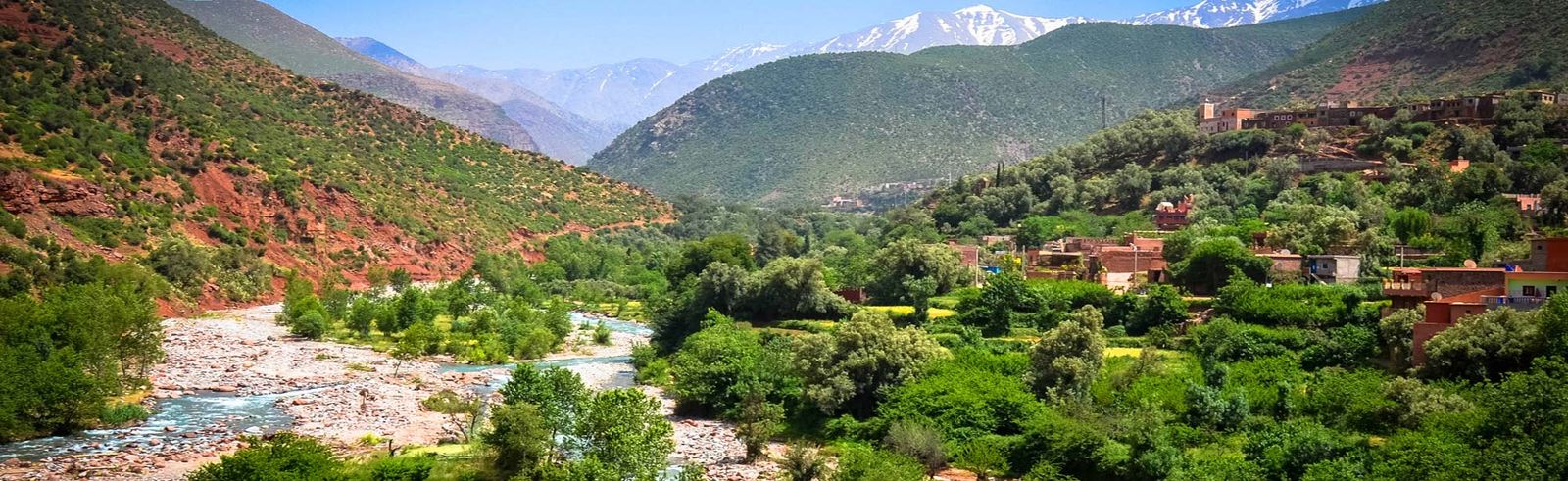
- Cooler than Marrakech all year, thanks to altitude and the river
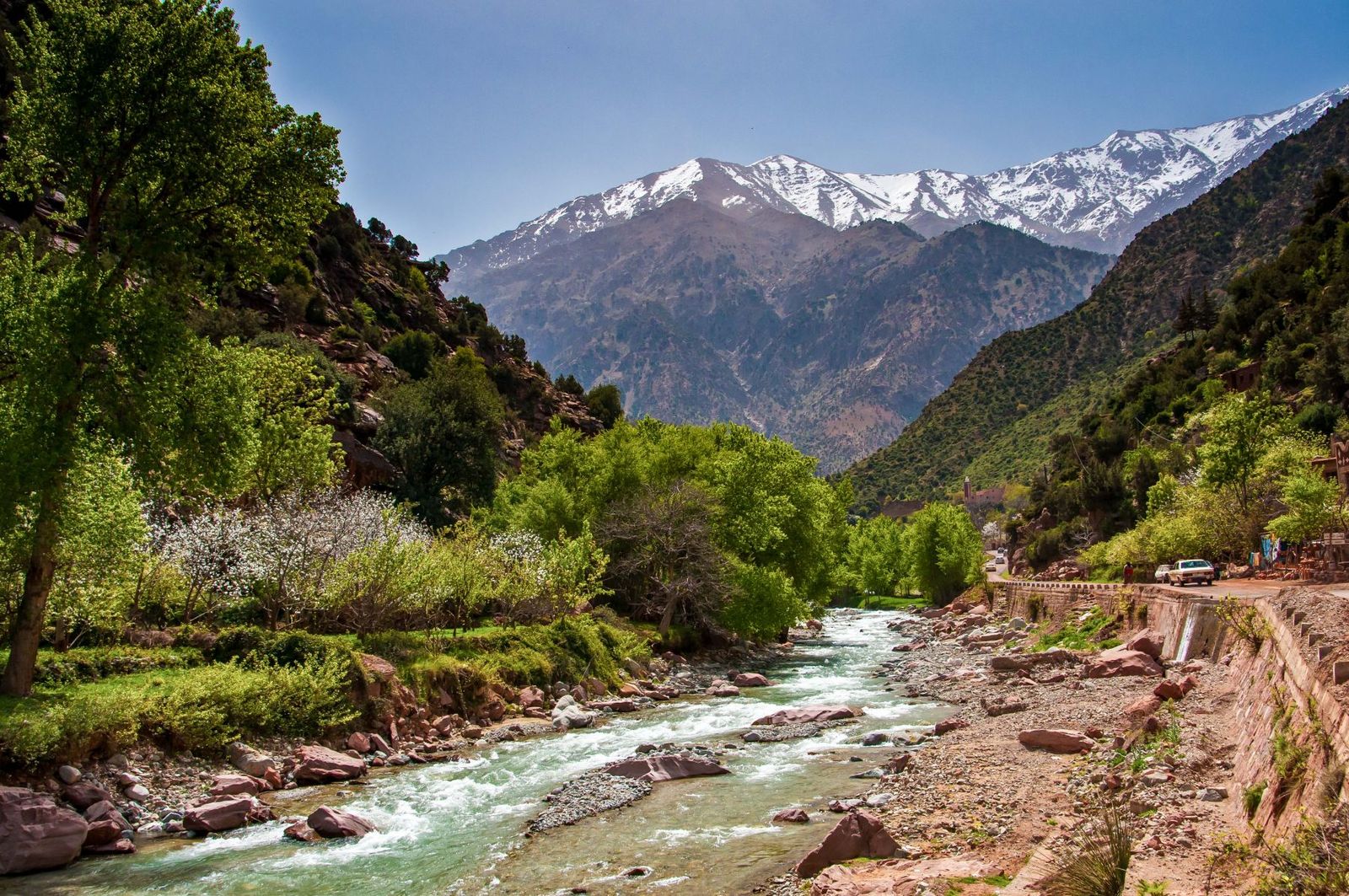
- Spring (March to May): strongest waterfalls, green orchards
- Summer: pleasant by the river, but watch afternoon storms
- Winter: cold mornings and snow on the High Atlas peaks
Short answers
What is the best month to visit the Ourika Valley?
April and May are the best months to visit the Ourika Valley: the waterfalls are full from the snowmelt, the orchards are green and the days are mild. Overall, the best periods are March to May, then late September to November; October, with calm weather, clear light and autumn colours, is our second favourite.
How much cooler is the Ourika Valley than Marrakech?
The Ourika Valley is clearly cooler than Marrakech: Setti Fatma sits at about 1,500 m, against about 450 m for the city, and the river and trees freshen the air. Average temperatures at Setti Fatma are about 5-7 °C in the coldest months and 18-22 °C in the warmest, while Marrakech has average July highs around 36 °C.
Is the Ourika Valley safe to visit in summer?
The Ourika Valley is safe in summer if you walk in the morning: the main risk is flash floods after afternoon thunderstorms in July and August. August has average lows and highs of about 17 and 32 °C in the lower valley, the most frequent storms and the busy moussem of Setti Fatma. Stay out of the riverbed when clouds build.
Does it snow in the Ourika Valley in winter?
Snow regularly covers the High Atlas peaks above the Ourika Valley in winter, but in the villages it is less common and does not last. Around Tnine Ourika, average lows and highs are about 3 and 16 °C in December and 1 and 15 °C in January. For real snow and skiing, the road from Aghbalou climbs to Oukaïmeden, at about 2,600 m.
The climate of the Ourika Valley is a mountain climate, cooler and more changeable than that of Marrakech, about 30 km to the north. Marrakech lies at about 450 m, while the valley climbs to about 1,500 m at Setti Fatma. In the lower valley around Tnine Ourika, average lows and highs run from about 1/15 °C in January to about 17/32 °C in July and August; Setti Fatma is a few degrees cooler. Spring, from March to May, is the best season: mild days and the strongest waterfalls. Summer is an escape from the city heat, but July and August afternoons often bring thunderstorms that can raise the river within minutes. Autumn is calm and colourful. Winter mornings are cold, with snow on the peaks and skiing at Oukaïmeden when there is enough snow, usually between January and March.
Guests often call us the evening before their trip to ask what the weather will be like up there. This guide sums up what we see through the year, based on the averages we could verify and on many days spent on the road and the paths.
What is the weather at Setti Fatma, Tnine Ourika and Oukaïmeden this week?
Here is the seven-day forecast for three points of the valley and, for comparison, for Marrakech. Setti Fatma is the village at the end of the road, where the walk to the waterfalls starts. Tnine Ourika is the entrance of the valley. Oukaïmeden is the high plateau above it, where snow falls in winter.
Ourika flood vigilance: orange
- Next 24 hoursorangepeak around 16:00 (02/11)
- 24 to 48 hoursorangepeak around 16:00 (03/11)
Storms are likely over the upper valley. The river can rise very fast: stay away from the riverbed and the waterfall path while a storm lasts. If the valley is not safe on the date of your trip, we offer another date or a full refund of the deposit.
Indicator calculated by our team from four weather models over the Ourika catchment, updated every 15 minutes (last update 02/11/2026 08:09, Morocco time). It is not an official warning: official alerts come from the national weather service (DGM) and the local authorities.
| Day | Setti Fatma (about 1,500 m) | Tnine Ourika (valley entrance) | Oukaïmeden (about 2,600 m) | Marrakech |
|---|---|---|---|---|
| Mon 2 Nov | 19° / 13° Rain · 73 % rain | 24° / 16° Showers · 50 % rain | 9° / 5° Showers · 100 % rain | 27° / 18° Rain · 43 % rain |
| Tue 3 Nov | 18° / 12° Thunderstorm · 90 % rain | 23° / 15° Rain · 78 % rain | 8° / 4° Thunderstorm · 100 % rain | 26° / 16° Showers · 68 % rain |
| Wed 4 Nov | 17° / 11° Showers · 38 % rain | 22° / 14° Showers · 38 % rain | 8° / 3° Showers · 38 % rain | 26° / 15° Overcast · 28 % rain |
| Thu 5 Nov | 17° / 12° Overcast · 3 % rain | 22° / 13° Overcast · 8 % rain | 8° / 4° Overcast · 3 % rain | 25° / 16° Overcast · 0 % rain |
| Fri 6 Nov | 20° / 13° Overcast · 3 % rain | 26° / 16° Overcast · 0 % rain | 10° / 6° Overcast · 5 % rain | 28° / 17° Overcast · 0 % rain |
| Sat 7 Nov | 23° / 14° Overcast · 3 % rain | 26° / 14° Overcast · 3 % rain | 15° / 7° Overcast · 11 % rain | 29° / 16° Overcast · 0 % rain |
| Sun 8 Nov | 24° / 17° Rain · 34 % rain | 29° / 18° Overcast · 34 % rain | 13° / 9° Rain · 55 % rain | 32° / 19° Overcast · 25 % rain |
Forecast updated on 2 November 2026 at 07:58 (Morocco time), refreshed every hour. Maximum / minimum temperature in °C, chance of rain in %. Weather data by Open-Meteo.
Why is the Ourika Valley cooler than Marrakech?
Marrakech sits on a plain at about 450 m. The Ourika Valley starts about 30 km to the south and climbs steadily into the High Atlas, reaching about 1,500 m at Setti Fatma, the village at the end of the road. That extra height alone makes a clear difference in temperature.
Two other things help. The Ourika river runs all year, fed by rain and snow on the peaks, and the air above the water and the irrigated orchards stays fresher. And the valley walls give shade for part of the day, especially in the narrow upper section. The result: on a July day when Marrakech bakes (average highs there are around 36 °C), a table by the river in Setti Fatma feels much more comfortable. At Setti Fatma, daily average temperatures (day and night together) run about 18-22 °C in the warmest months and about 5-7 °C in the coldest.
The flip side is that the mountains make the weather less predictable. Clouds build quickly over the peaks, and a sunny morning can turn into a stormy afternoon, especially in summer.
The seasons in the valley
Spring (March to May): the best season
This is the time we recommend most. The snow on the High Atlas melts, the river is high and the Setti Fatma waterfalls are at their strongest. The orchards are in leaf or blossom, the terraced fields are green, and days are mild enough to walk comfortably at any hour. It is also the season of birdsong and nesting, as our guide to the valley's nature and wildlife explains. Showers are possible, especially in March and April, and the river can be too high to cross on some days after heavy rain.
Summer (June to August): escaping the heat, with care
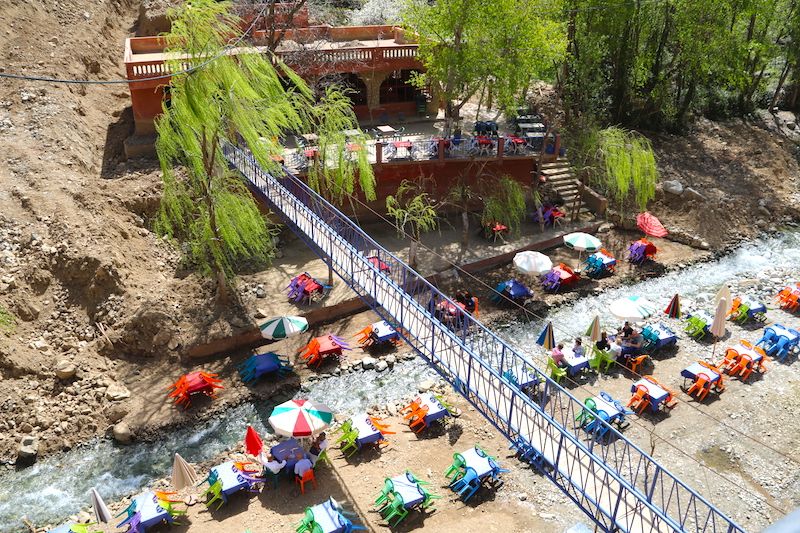
Summer is when Marrakech families come up to cool off by the river, so weekends are busy. Mornings are pleasant and the shade of the walnut trees makes lunch by the water a real pleasure. But afternoon thunderstorms are common in July and August, and they are the main weather risk in the valley (see below). The waterfalls are lower than in spring, and after a dry year the first fall can be modest.
Autumn (September to November): quiet and colourful
September can still be warm, with occasional storms early in the month. October and November are calm, with clear light, fewer visitors and the leaves of the walnut and poplar trees turning yellow. It is a lovely time for walking between villages, as on our trek with lunch in a Berber family. The waterfalls are at their lowest before the autumn rains.
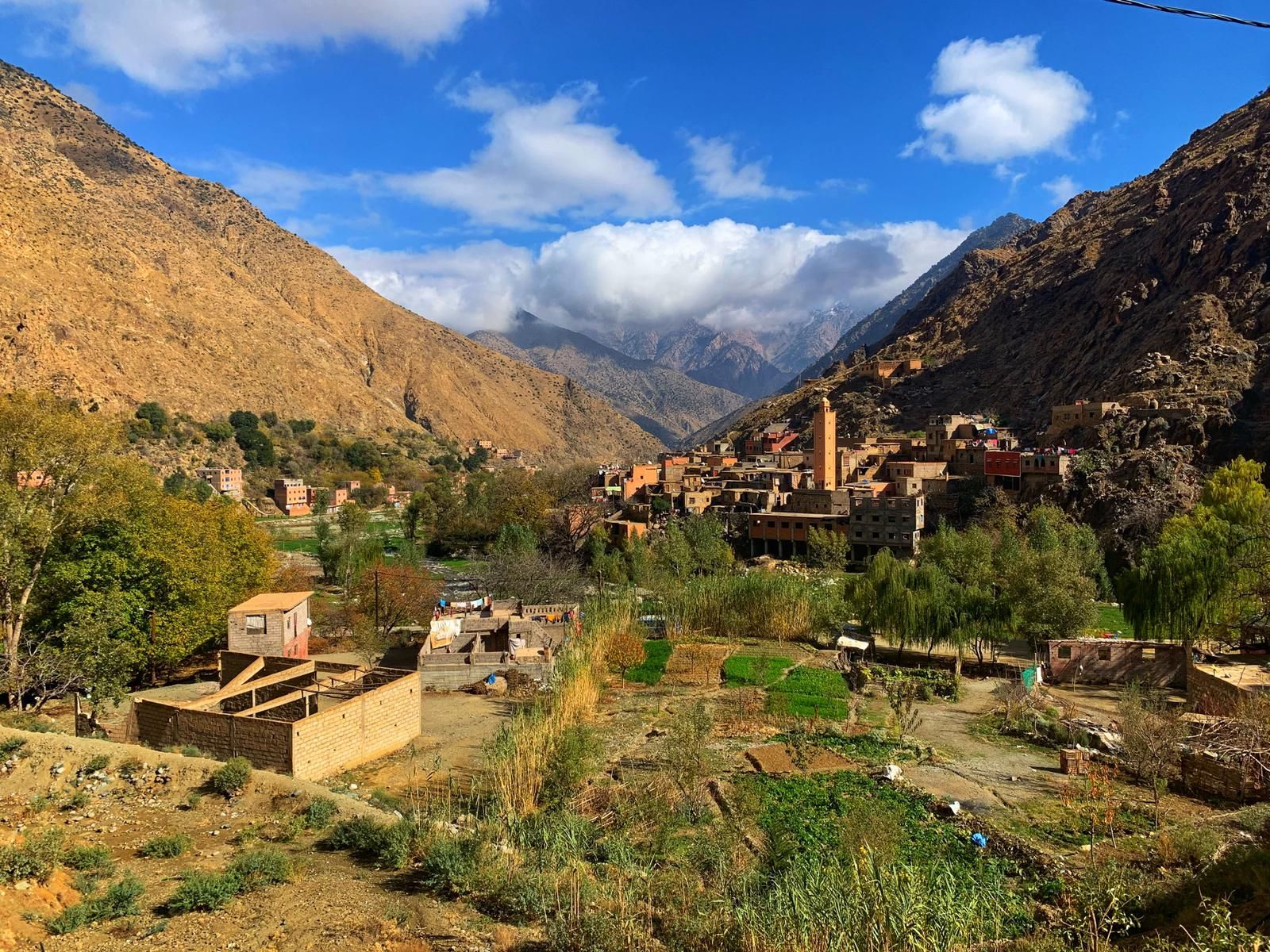
Winter (December to February): snow on the peaks
Winter days are often clear and sunny, with the High Atlas peaks white with snow above the valley. Mornings and evenings are cold, and the gorge stays in shade for much of the day. Rain and occasional snow in the higher villages are possible. A clear winter day in the valley is beautiful and quiet; a wet one is best spent elsewhere. When there is enough snow, usually between January and March, skiing is possible at Oukaïmeden, reached from Aghbalou. Our guide to the Ourika Valley in winter covers temperatures, daylight and the holidays.
What is the weather like each month?
The table below combines our own experience with approximate average lows and highs for the lower valley around Tnine Ourika, rounded from climate-data.org. Setti Fatma, higher up, is a few degrees cooler, and conditions vary a lot from one year to the next.
| Month | Conditions | Lower valley, low/high (about) | Good for |
|---|---|---|---|
| January | Coldest month, crisp clear days, snow on the peaks, cold mornings | about 1/15 °C | Snowy views, quiet visits, skiing at Oukaïmeden if snow |
| February | Still cold, more rain possible, first blossom lower down | about 2/16 °C | Quiet valley, snow on the peaks |
| March | Milder, showers, river rising with the snowmelt | about 5/19 °C | Waterfalls, blossom, walks |
| April | Mild and green, occasional rain, strong waterfalls | about 7/21 °C | Waterfalls, walks between villages, photos |
| May | Warm days, cool evenings, river still high | about 10/24 °C | Waterfalls, lunch by the river, trekking |
| June | Warm, dry, busier at weekends | about 14/28 °C | Escaping the city heat, river restaurants |
| July | Hot days, afternoon thunderstorms possible | about 17/32 °C | Morning walks, cool lunch by the water |
| August | Hot, most frequent storms, moussem at Setti Fatma, very busy | about 17/32 °C | Early starts, festival atmosphere |
| September | Warm, storms early in the month, calmer later | about 14/27 °C | Quieter visits, village walks |
| October | Mild, clear light, autumn colours | about 11/24 °C | Walking, photos, cooperatives |
| November | Cooler, first rains, yellow leaves | about 6/18 °C | Calm visits, trekking |
| December | Cold mornings, snow returns to the peaks | about 3/16 °C | Winter light, quiet day trips |
Summer storms and flash floods
Latest news: storms and flash floods in the Ourika Valley in October 2026.
This is the one weather point we take very seriously. In July and August, heat rising over the mountains often builds thunderstorms in the afternoon. Heavy rain high up can send a surge of muddy water down the river and the side gorges within minutes, sometimes while the sky over the village still looks fine.
Since the flash flood of 17 August 1995, people here watch the sky and the river closely on summer afternoons. A network of gauging stations and warning posts along the valley was completed in December 2013.
Our rules in summer:
- Do the waterfall walk in the morning and be back in the village by early afternoon.
- If you hear thunder or see dark clouds over the peaks, leave the riverbed and the gorge.
- If the water turns brown or starts rising, move away from the river at once.
- Follow restaurant owners and guides: when they pull tables out of the river, there is a reason.
We check the forecast before each departure. If weather or river conditions make the valley unsafe, we offer another date or a full refund.
What should you pack for the Ourika Valley?
- All year: closed shoes with a good grip, a small backpack, water, sunscreen, hat, sunglasses, some cash in small notes.
- Spring and autumn: a light fleece or jacket for the gorge and the drive back, and a rain layer in March, April and November.
- Summer: light, breathable clothes that cover shoulders and knees, a spare T-shirt if you plan to paddle, and a light layer for the evening if you stay overnight.
- Winter: a warm jacket, a hat and gloves for the mornings, and shoes that cope with wet, cold rock.
The weather is also a question of timing inside the day. Our Ourika Valley day trip starts in the morning precisely so that you walk while it is cool and calm, and sit down to lunch by the river when the sun is highest. If you would like more time in the valley, a night there gives you the fresh evening and early morning air: see where to stay in the Ourika Valley, or plan your day with our list of things to do in the valley.
Sources
- Climate-data.org, climate of Douar Ourika (monthly averages for the lower valley)
- Saidi et al. (2010), The Ourika floods (High Atlas, Morocco), Comunicações Geológicas 97 (summer storms, flood rise times, the flood of 17 August 1995; in French)
- JICA, flood warning project in the Ourika and Rheraya basins, follow-up report (2015)
Frequently asked questions
What is the best month to visit the Ourika Valley?
April and May are hard to beat: the waterfalls are full from the snowmelt, the orchards are green and days are mild. October is our second favourite, with calm weather, clear light and autumn colours. Summer is fine for escaping the heat, as long as you do the waterfall walk in the morning.
How much cooler is the Ourika Valley than Marrakech?
It depends on where you are in the valley and the time of day, but the difference is clearly felt. Setti Fatma sits at about 1,500 m, roughly a kilometre higher than Marrakech, and the river and trees keep the air fresher. In summer evenings and in the gorge, you may want a light layer.
Does it snow in the Ourika Valley?
Snow regularly covers the High Atlas peaks above the valley in winter, and it is a beautiful sight from Setti Fatma. Snow in the villages themselves is less common and does not last long. For real snow and skiing, the road from Aghbalou goes up to Oukaïmeden, at about 2,600 m.
Is it dangerous to visit the Ourika Valley in summer?
Not if you respect a few rules. The risk is flash floods after afternoon thunderstorms in July and August. Walk in the morning, stay out of the riverbed if clouds build over the peaks, and follow the advice of guides and restaurant owners. We check the forecast before every trip.
What should I wear for a day in the Ourika Valley?
Light clothes covering shoulders and knees, closed shoes with a good grip for the waterfall path, a hat and sunscreen, plus a warm layer outside summer. From November to March, bring a proper jacket: mornings and evenings in the valley can be cold even on sunny days.
Is the Ourika Valley worth visiting in winter?
Yes, on a clear day. The air is crisp, the peaks are white, the valley is quiet and lunch in the sun by the river is a real pleasure. The waterfalls can be lower and the rocks cold and slippery, so be careful on the path. Rainy days are best avoided.
What is the Ourika Valley like in December and January?
Cold mornings, crisp clear days and snow on the peaks. In the lower valley around Tnine Ourika, average lows and highs are about 3 and 16 °C in December and about 1 and 15 °C in January, and Setti Fatma is a few degrees cooler. The valley is quiet, and there is skiing at Oukaïmeden when there is enough snow.
What is the Ourika Valley like in August?
Hot days, with average lows and highs of about 17 and 32 °C in the lower valley, still cooler than Marrakech. August has the most frequent afternoon thunderstorms and the moussem of Setti Fatma, so the valley is very busy. Start early, walk in the morning and watch the sky.